
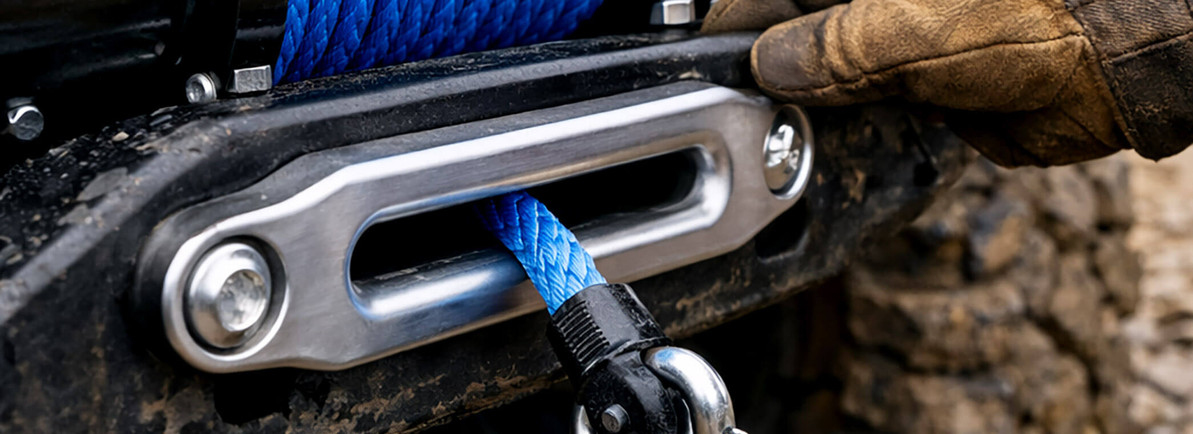
How to Secure a Synthetic Winch Rope to a Winch (Correctly & Safely)
Synthetic winch lines (often HMPE/UHMWPE) deliver high strength with less weight—when they’re installed and terminated correctly. This guide covers the most common drum attachment methods, best-practice spooling, and the hardware that helps protect your rope and increase reliability.
Use the winch manufacturer’s approved drum-anchor method, then spool the first layer under tension with tight, even wraps. Protect the line where it sees abrasion and heat (fairlead, drum edges, and termination hardware), and inspect before each use.
Before you start: tools & checks
Don’t treat rope installation as “just tying it on.” The drum anchor, rope termination, and first wraps determine how the entire line behaves under load.
- Gloves and eye protection
- Wrench/socket set for drum-anchor hardware (if your winch uses it)
- A fid/splicing kit if you’re making or repairing a termination (optional)
- A clean rag + mild cleaner to remove grit from the drum and fairlead surfaces
- Confirm rope diameter/length matches your winch drum capacity and application requirements.
- Inspect the rope for cuts, glazing, flattened sections, or pulled strands before installing.
- Inspect drum edges and fairlead surfaces for burrs, sharp corners, or gouges that can cut fibers.
- Use the manufacturer-approved drum anchor method for your specific winch model.
3 common attachment methods
Your winch drum is designed for one (sometimes two) approved attachment methods. Choose the method that matches your drum hardware and the rope you’re using. If your rope is pre-spliced, keep that factory termination intact and focus on correct drum anchoring and spooling.
| Method | Where it’s used | Best practice |
|---|---|---|
| Drum anchor (bolt/set-screw/slot) | Most electric and planetary gear winches | Secure the tail properly, then rely on tight first wraps under tension (not the anchor) to carry load. |
| Loop & bolt / eye-to-drum point | Some drums provide a dedicated attachment point | Use a correctly sized loop/eye, keep the bend radius generous, and avoid sharp hardware edges. |
| Pre-spliced line + protected termination | Common on purpose-built synthetic winch lines | Use a thimble/hook/shackle setup that matches load path and prevents fiber pinch and abrasion. |
Method 1: Drum anchor (bolt/set-screw/slot)
- Clean the drum and fairlead contact surfaces to remove grit that can abrade fibers.
- Route the rope through the fairlead, then onto the drum in the correct winding direction.
- Secure the rope tail using the winch’s specified anchor point (bolt, clamp, set-screw, or slot).
- Important: the anchor retains the tail; the first full layer of tight wraps carries working load.
- Proceed to “Spooling correctly” below to set the line under proper tension.
Method 2: Loop & bolt technique
- Create or use an appropriately sized loop/eye at the rope end (spliced eye preferred for strength consistency).
- Place the loop over the drum’s attachment point (bolt/pin/clevis) as designed by the manufacturer.
- Tighten hardware to the manufacturer’s guidance; keep the rope aligned to prevent twisting at the attachment.
- Continue to spooling under tension to prevent rope burying and uneven layers.
Method 3: Termination hardware (thimble + hook/shackle)
Most professional-grade synthetic winch lines ship with a protected eye (often with a thimble) to reduce abrasion at the connection point. Choose hardware that supports the rope’s bend radius and avoids sharp edges.
- Thimbles: help maintain eye shape and protect fibers where they wrap around hardware.
- Hooks: useful for frequent connections; choose styles that protect the rope and match your load path.
- Shackles: ideal for secure connections and recovery points; select by WLL and fit.
Spooling correctly (the part that prevents failures)
Synthetic line performance is heavily influenced by how it’s spooled. Loose wraps can “bury” under load, bind the drum, and damage fibers. Set the first layer carefully—tight, even, and under controlled tension.
- With the rope anchored to the drum, pull out enough line to create a straight, controlled lead-in angle.
- Apply steady tension while winching in (a controlled load is ideal; avoid free-spooling loose rope onto the drum).
- Guide the line so wraps lay snugly side-by-side on the first layer.
- Build subsequent layers evenly across the drum to prevent high spots and pinching.
- Stop if you see crossover, bunching, or uneven stacking; correct it before loading the line.
Never rely on the drum anchor alone to hold working load. The anchor retains the tail; the friction and compression of tight wraps carries load on the drum.
Protecting synthetic rope from abrasion & heat
Synthetic fibers can outperform steel cable in many use cases, but they are more sensitive to sharp edges, grit, and heat buildup. Use protection where the rope contacts metal or rough surfaces.
- Fairlead contact: keep surfaces smooth and matched to synthetic line use.
- Termination zone: use a thimble or protected eye to reduce fiber pinch and abrasion.
- Chafe points: add a sleeve/guard anywhere the rope might rub against edges or obstacles.
- Heat management: avoid high-friction situations that can generate heat at the fairlead and drum.
Many purpose-built synthetic winch lines include a chafe sleeve near the termination. If your application includes frequent rubbing or edge contact, add protective sleeve material before damage happens.
Inspection & retirement guidelines
Inspection is the most effective risk reducer in winching and rigging. Inspect the rope, drum, fairlead, and connection hardware before each use. When in doubt, follow the rope and winch manufacturer’s criteria for removal from service.
- Deep cuts, melted/glazed areas, or stiffness from heat exposure
- Severe abrasion or thinning, especially near the fairlead and termination
- Pulled strands, broken yarns, or structural distortion in braided construction
- Hardware damage: sharp burrs, bent hooks, deformed thimbles, or questionable pins
Common mistakes to avoid
- Overloading: exceeding the rated capacity of the winch, rope, or connection hardware.
- Loose spooling: allowing rope to wind in without tension, which increases burying and damage risk.
- Ignoring abrasion points: running synthetic rope over sharp edges without a sleeve/guard.
- Using the wrong connection hardware: mismatched pin sizes, sharp radii, or hardware not suited to the load path.
- Skipping inspection: not checking rope condition, drum edges, and fairlead surfaces before use.
Shop the right gear (with quick category intros)
These category pages and resources are directly relevant to synthetic winch rope installation and protection. Each link below is a working URL on lifting.com.
Winch Lines, Cables & Synthetic Winch Rope
Find synthetic winch lines and steel winch cables by diameter, strength, and application. If you’re upgrading to synthetic, this is the fastest way to match the right line to your winch and usage.
- Shop by rope size and breaking strength
- Options built for off-road, recovery, and mobile operations
- Easy comparison between synthetic rope and steel cable
Thimbles (Protect the Rope Eye)
Thimbles help maintain a proper eye shape and reduce fiber wear where the line connects to hooks or shackles. They’re one of the simplest upgrades for longer service life.
- Reduce abrasion at the termination
- Maintain bend radius and eye geometry
- Useful for winch lines, slings, and rope assemblies
Sling Protection, Wear Pads & Chafe Guards
If your synthetic rope contacts rough surfaces, edge protection is non-negotiable. Sleeve and guard products act as a sacrificial layer to prevent expensive rope damage.
- Shield rope from abrasion and sharp edges
- Great for fairlead contact and field recovery scenarios
- Extends service life of synthetic products
Shackles (Secure, Load-Rated Connections)
Shackles are often the “small part” that controls the safety margin. Choose by WLL, fit, and connection geometry—especially when pairing with synthetic eyes and thimbles.
- Anchor, chain, screw pin, and specialty options
- Reliable connections for recovery points and rigging
- Match pin size to the eye/thimble and load path
Hoist & Winch Hooks
For frequent connect/disconnect workflows, a properly selected hook can improve speed and consistency—without sacrificing control. Choose hook style and latch type based on your application and connection points.
- Hook styles for lifting, pulling, and winching workflows
- Latch and safety options to reduce unintentional release
- Pair with thimbled eyes for better rope protection
Recommended reading
- Is Synthetic Winch Rope Worth It?
A practical overview of benefits, tradeoffs, and why synthetic is often preferred for many operations.
- What Is Better for a Winch: Rope or Cable?
A comparison guide to help you choose based on environment, abrasion exposure, and maintenance.
- What Are the Different Types of Thimbles in Rigging?
Learn how thimble style and selection affects rope wear and connection safety.
Need help selecting the right winch line or connection hardware?
The safest system is the one where rope size, termination, and hardware all match the load path. If you’re unsure, start with a purpose-built synthetic winch line and protect it with the right termination and chafe control.
Browse Winch Lines
What Are the Two Types of Lifting Beams?
Apr 9th 2026
What Is an Eye Bolt Used For?
Apr 3rd 2026
How to Determine Chain Binder Size
Mar 30th 2026

Is a Safety Harness Considered Fall Protection?
Mar 16th 2026
What Is the Difference Between a Gantry Crane and a Davit Crane?
Mar 13th 2026

Do Lifting Chains Need to Be Certified?
Mar 10th 2026

What Type of Chain Is Used for Overhead Lifting?
Mar 6th 2026
Essential Equipment Used in Logging (The Gear That Actually Moves Wood)
Mar 4th 2026
Ratchet vs. Lever Chain Binders: Which Is Better for Your Load?
Mar 2nd 2026